March 1, 2010

Lviv

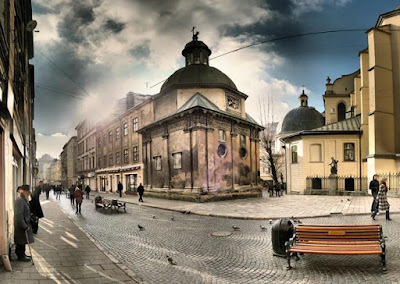
Lviv is a charming city with typical west European architecture. Looking down from Zamkova hora (Castle Hill), the highest hill of Lviv, to the historical centre of the city, a UNESCO World Heritage Site, it is easy to understand why it is called the “Florence of the east”.

Lviv

Lviv was founded in 1256 by King Daniel of Galicia and named after his son Lev (Lion). For a long time, Lviv was annexed by Poland, then the Austro-Hungarian Empire, and in 1939 was captured by the Soviet Union. Lviv has always been the centre of the national liberation struggle of Ukrainian people against Communist dictatorship.

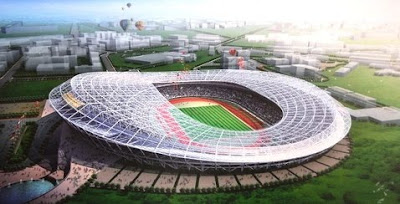
Lviv stadium

Lviv has a special aura that cannot be expressed in words – it can only be felt by walking along the narrow streets, visiting the famous Lviv opera house or enjoying flavoured coffee. Only here can you try live beer, brewed according to ancient recipes.

Kiev

On the right bank of the Dnipro river, a monument depicts a boat carrying the four Slavic siblings said to have founded Kiev – the sister Lybid and her three brothers, Kyj, Schek and Khoryv. It is the eldest brother, Kyj, who gave his name to the city, which, since its founding in the 5th century, has been a very important commercial, cultural, political and religious centre.

Kyiv
Kiev was the capital of the eastern Slavs’ first great civilisation, Kievan Rus, between the 10th and 13th centuries. Kiev knew its greatest prosperity at the end of 10th century, during the rule of Volodymyr the Great, who introduced Orthodox Christianity in 988.

Kiev

Over the centuries Kiev has attracted numerous invaders. The city survived the destruction of the Mongols in 1240, was part of the Grand Duchy of Lithuania in the 14th century and then of the Polish-Lithuanian Commonwealth. In time, Kiev was occupied by Russia, and until the end of the 20th century, like all of Ukraine, was part of the USSR. In 1991 Ukraine regained its independence.

Kiev stadium

Today Kiev is a modern city with a population of 3 million, the capital of Ukraine. There are many architectural monuments, more than 100 museums, 33 theatres, 141 libraries. All the best universities are concentrated here, including the Kiev-Mohyla Academy, one of the oldest educational institutions in Europe.

Kharkov

The territory of modern Kharkov began to be habitable by people in deep antiquity. In the 8th century, Slavs created a settlement on the site of modern Kharkov, which in the 10th century grew into the city called Donets, an important centre of handicrafts and trade. In the middle of the 13th century, the city was totally destroyed by the Mongols.

Kharkov

Traditionally, it is believed that the modern city of Kharkov was founded by Ukrainian Cossacks in the middle of the 17th century. The name Kharkov, according to legend, comes from the Cossack Kharko (Khariton), one of the first settlers.

Kharkov stadium

After being completely destroyed during World War II, Kharkov, one of the largest cities in Ukraine, quickly returned to being a centre of industry and science. Kharkov is known for high-level nuclear technology, engineering and metalworking, specialising in the production of military equipment, turbines and aircraft. Its 13 universities and numerous technical institutions attract some 10,000 foreign students each year. During the 1970s, a human rights protection movement was established there.

Donetsk

Donetsk was founded in 1869 by Welsh businessman John Hughes, who established coal industry in the region. He set up a steel mill and several coal mines. The workers’ village was named Uzivka after him, based on the local pronunciation of Hughes.

Donetsk

During the communist regime, Uzivka became Stalino in 1921, and after the fall of the Stalin regime, the city was renamed Donetsk, after the Siverskyi Donets river, a tributary of the Don.

Donetsk

Donetsk today is a huge industrial and financial centre in eastern Ukraine, where almost all industries are represented, including, predominantly, metallurgy, coal, chemicals and engineering. In 1970 the city was recognised by UNESCO as the greenest industrial city in the world, and it still adequately deserves the title, Donetsk being very pleasant, well-kept and green.

Donetsk

The city is often called the mining capital, but Donetsk is not only coal; it is also a city of football, the home of Shakhtar Donetsk. It also has one of the best stadiums in Europe, the Donbass Arena.